
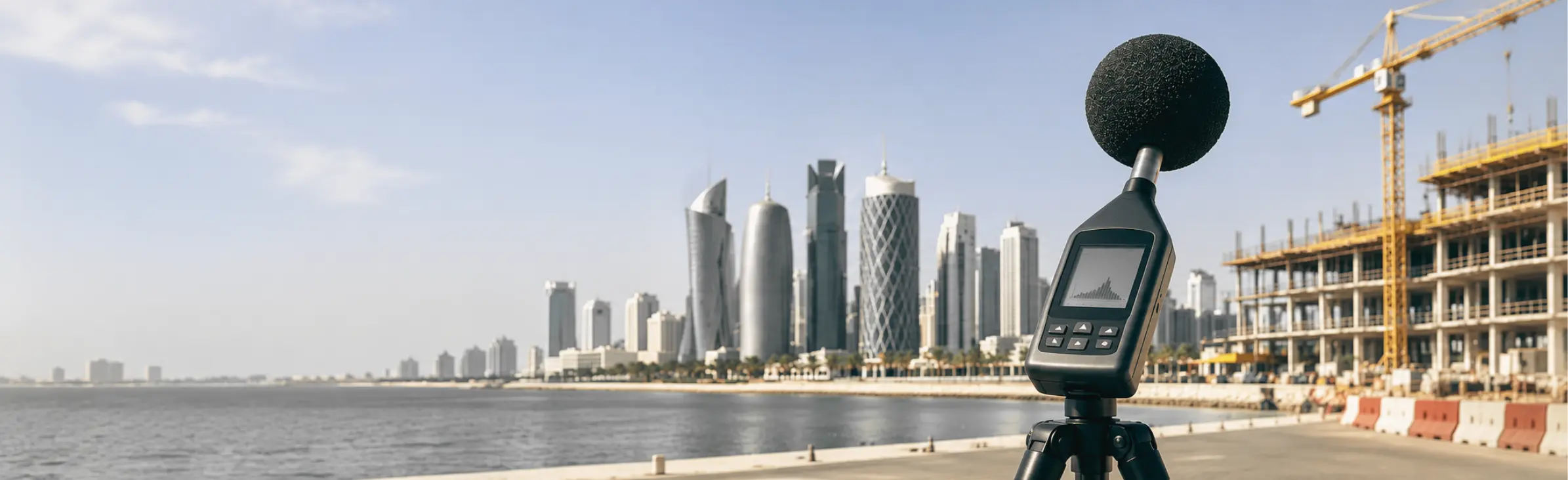
Noise Monitoring: Noise Assessment, Testing and Measurements
Noise rarely looks like a hazard, yet it damages hearing, disturbs sleep and breaks the law when it passes a limit. At METS Laboratories in Qatar, our noise monitoring records sound levels at construction sites, factories, buildings and neighbourhoods. Our noise assessment then compares those levels with the limits that apply, so you know where you stand. As a result, owners, contractors and employers get noise testing and measurements they can act on.
What Is Noise Monitoring?
Noise monitoring measures sound levels over time, and noise assessment judges those levels against a limit or a design target.
- Noise monitoring: Calibrated instruments record sound pressure levels in decibels at set locations.
- Noise assessment: An engineer compares the results with legal limits, standards or project criteria.
- Noise testing and measurements: Specific tests also check how well buildings and equipment control sound.
Importance of Noise Monitoring
Sound levels affect people and projects, so noise monitoring supports several goals.
- Hearing protection: Workers exposed to high noise can lose hearing permanently, so employers measure first.
- Legal compliance: Qatar’s Environment Protection Law (Law No. 30 of 2002) and its Executive By-law set allowable noise limits.
- Community relations: Measured data also helps resolve complaints from neighbours.
- Comfort and productivity: Quiet offices, classrooms and hospital wards support concentration and recovery.
- Design verification: Tests confirm that walls, floors and equipment meet the specified performance.
Types of Noise Measurements
Different situations need different noise testing and measurements, so we select the type to match your purpose.
- Environmental noise: Ambient and boundary measurements near homes, roads, plants and sensitive sites, often over 24 hours.
- Occupational noise: Area surveys and personal dosimetry also show how much noise workers receive during a shift.
- Construction noise: Monitoring at site boundaries checks that piling, demolition and plant stay within limits, because these activities are loud.
- Building acoustics: Field tests measure airborne and impact sound insulation, façade performance, reverberation time and noise from building services.
- Industrial and machinery noise: Sound power and source measurements identify the loudest equipment, so engineers can target controls.
What Do We Measure?
Noise levels use the A-weighted decibel, dB(A), because it follows how the human ear responds.
| Parameter | What It Shows |
|---|---|
| LAeq | Average (equivalent continuous) sound level over the measurement period |
| LAmax and LAmin | Highest and lowest levels recorded |
| LA10 and LA90 | Levels exceeded for 10% and 90% of the time, so LA90 shows background noise |
| Lden or Ldn | Day-evening-night or day-night level for community noise |
| TWA and noise dose | Time-weighted average exposure for a work shift |
| LCpeak | Instantaneous peak level, important for impulse noise |
Noise Testing Methods
The method depends on the purpose, but a typical noise survey follows the same principles.
- Instruments: Class 1 sound level meters meet IEC 61672-1, while personal dosimeters track worker exposure.
- Calibration: We check the meter with an acoustic calibrator before and after each survey.
- Positions: Microphones sit at set heights and distances from reflecting surfaces, as the standard specifies.
- Duration: Spot checks last minutes, whereas long-term monitoring logs for 24 hours or several days.
- Analysis: We separate background noise from the source, and then calculate the indicators above.
Environmental Noise Assessment
Environmental noise assessment involves measuring outdoor sound levels and evaluating their potential impact on nearby communities, wildlife and surrounding infrastructure. These assessments are commonly conducted to:
- Determine the impact of noise on surrounding communities.
- Monitor noise generated by road traffic and industrial activities.
- Provide supporting data for Environmental Impact Assessments (EIA).
Our evaluations are based on the following standards:
- ISO 1996 Series
- ISO 9613
- ASTM E1014
- ASTM E1053
Sound Insulation Testing in Buildings
Sound insulation testing evaluates how effectively building elements, such as walls, floors and ceilings, prevent sound from travelling between spaces. Measurements can be performed under controlled laboratory conditions or directly at the building site, depending on the assessment requirements.
Laboratory Measurement (ISO 10140)
ISO 10140 outlines laboratory procedures for evaluating the airborne and impact sound insulation performance of building components. During airborne sound insulation testing, sound transmission through a partition is measured between a source room and a receiving room. The results are used to determine the Weighted Sound Reduction Index (Rw), which provides a single-number rating of the element's sound insulation performance.
Field Measurement (ISO 16283-1)
The acoustic performance of a building element may differ between laboratory conditions and an actual building due to installation quality, flanking transmission and surrounding construction. To evaluate real-world performance, we conduct on-site airborne sound insulation measurements in accordance with ISO 16283-1. The assessment determines how effectively walls, floors and ceilings reduce sound transmission between rooms. Results are expressed using single-number ratings, including the Weighted Standardized Level Difference (DnT,w).
Impact Noise Insulation (IIC)
Impact noise is generated by physical contact with building surfaces, such as footsteps, dropped objects and furniture movement. Impact Insulation Class (IIC) testing evaluates the ability of floor and ceiling assemblies to minimise the transmission of this type of noise. It is widely used to assess acoustic performance in residential and commercial buildings.
We conduct impact noise evaluations based on the following standards:
- ASTM E492-15 / ASTM E989-06
- ISO 10140-5:2010
- ISO 717-2:2013
Impedance Tube Testing
Impedance tube testing is used to evaluate the acoustic properties of smaller material samples, including acoustic foam, fabrics and sound-absorbing panels. Following ASTM E1050 or ISO 10534-2, sound waves are directed towards a sample placed inside a tube, and the relationship between incident and reflected sound waves is measured.
Noise Measurement Standards
The right standard depends on the type of measurement and your market.
| Standard | Typical Use |
|---|---|
| ISO 1996-1 and ISO 1996-2 | Description, measurement and assessment of environmental noise |
| ISO 9612, ASTM E336 | Determining occupational noise exposure |
| OSHA 29 CFR 1910.95 | Occupational noise exposure limits |
| BS 5228-1 | Noise control on construction and open sites |
| ISO 16283-1, -2 and -3 | Field measurement of airborne, impact and façade sound insulation |
| ISO 3382-2 | Reverberation time in ordinary rooms |
| ISO 16032 | Sound from building service equipment |
| ISO 3744 | Sound power levels of noise sources |
| IEC 61672-1 and IEC 60942 | Sound level meters and acoustic calibrators |
| ISO 10848, ASTM E1007 | Vibration & Structure-Borne Noise Testing |
| ISO 3822 | Plumbing & Water Flow Noise Testing |
Noise Monitoring Rules in Qatar
Noise monitoring in Qatar is guided mainly by the Environmental Protection Law No. 30 of 2002 and its Executive By-Law, issued under Resolution No. 4 of 2005. Together they set the permitted noise levels and the duty to control noise pollution.
Several other bodies add technical detail:
- Ministry of Environment and Climate Change (MECC): technical guidelines on noise
- Qatar Construction Specifications (QCS): requirements for construction work
- Ashghal (Public Works Authority): rules for construction and infrastructure projects
Some projects have extra requirements. These include sites working to QatarEnergy standards, projects assessed under the Global Sustainability Assessment System (GSAS), and vehicle or traffic noise covered by Ministry of Interior regulations. Standards from the Qatar General Organization for Standardization and Metrology may also apply.
Noise Limits in Qatar
Qatar sets the maximum allowed ambient noise by type of area, with separate limits for day and night. The values below are in dB(A), which is sound measured the way the human ear hears it, and are averaged over 20 minutes.
| Type of Area | Daytime | Night-time |
|---|---|---|
| Residential areas and public corporations | 55 | 45 |
| Commercial areas | 65 | 55 |
| Industrial facilities | 75 | 75 |
The area type depends on what makes up most of the buildings:
- Residential: more than half the buildings are homes, including schools, hospitals and mosques.
- Commercial: more than half are stores, offices, garages or other places of work.
- Industrial: more than half are industrial facilities.
Inside workplaces, the rules look at exposure rather than ambient noise. The general limit is 85 dB(A) over an 8-hour working day, and the permitted time shortens as the noise gets louder.
Vehicle noise in Qatar is capped by Gulf (GSO) standards enforced through Ministry of Commerce and Industry Circular No. 3 of 2023, with limits of 78 to 79 dB(A) for most passenger cars and 75 to 80 dB(A) for motorcycles. The Ministry of Interior (MoI) also applies a general ceiling of 79 dB to all vehicles, and tampering with the exhaust or muffler is treated as a violation.
Who Needs Noise Monitoring and Noise Assessment?
Anyone who creates noise, or lives and works near it, can benefit from noise monitoring.
- Construction companies and developers: Monitor site boundaries and meet permit conditions.
- Environmental consultants: Collect baseline data for impact assessments.
- Factories and industrial plants: Identify loud equipment and plan controls.
- Oil, gas and petrochemical sites: Survey workplace exposure across large areas.
- Hotels, hospitals and schools: Verify indoor noise levels for comfort and care, especially in wards and classrooms.
- Residential and commercial developers: Confirm insulation and façade performance before handover, so buyers receive quiet homes.
- HSE teams: Support hearing conservation programmes with exposure data.
METS Laboratories for Noise Monitoring
Our noise monitoring covers the main measurement types in one place, and four points set it apart.
- Range of measurements: Environmental, occupational, construction and building acoustic tests are also available together.
- Calibrated instruments: Sound level meters and calibrators also follow recognised standards.
- Clear assessment: We compare results with the limits that apply, so you see pass or fail at a glance.
- Practical recommendations: Reports suggest controls, such as barriers, scheduling changes or equipment fixes.
METS Laboratories delivers a complete portfolio of environmental monitoring services built on ISO/IEC 17025-accredited methodologies. These services support compliance with global and regional standards, including ISO, OSHA, EN, BS and GCC environmental frameworks.
Conclusion
You cannot judge noise by ear, because the ear adapts and the law uses numbers. If you build, run or live next to a noisy site, noise monitoring gives you evidence. Then your noise assessment shows what to change and what to keep. Contact METS Laboratories to discuss noise testing and measurements for your project.
Frequently Asked Questions
What is the difference between noise monitoring and noise assessment?
Noise monitoring measures sound levels. Noise assessment then compares those levels with a limit or a target and explains the result.
What does dB(A) mean?
It is a decibel level adjusted to match human hearing, so it reflects what people actually hear.
How long should noise be measured?
It depends on the purpose. Short spot checks suit simple questions, whereas 24-hour or multi-day logging suits compliance and baseline studies.
At what level does workplace noise become a risk?
Many standards use an action level of 85 dB(A) averaged over eight hours. Please check the limit that applies in Qatar.
