
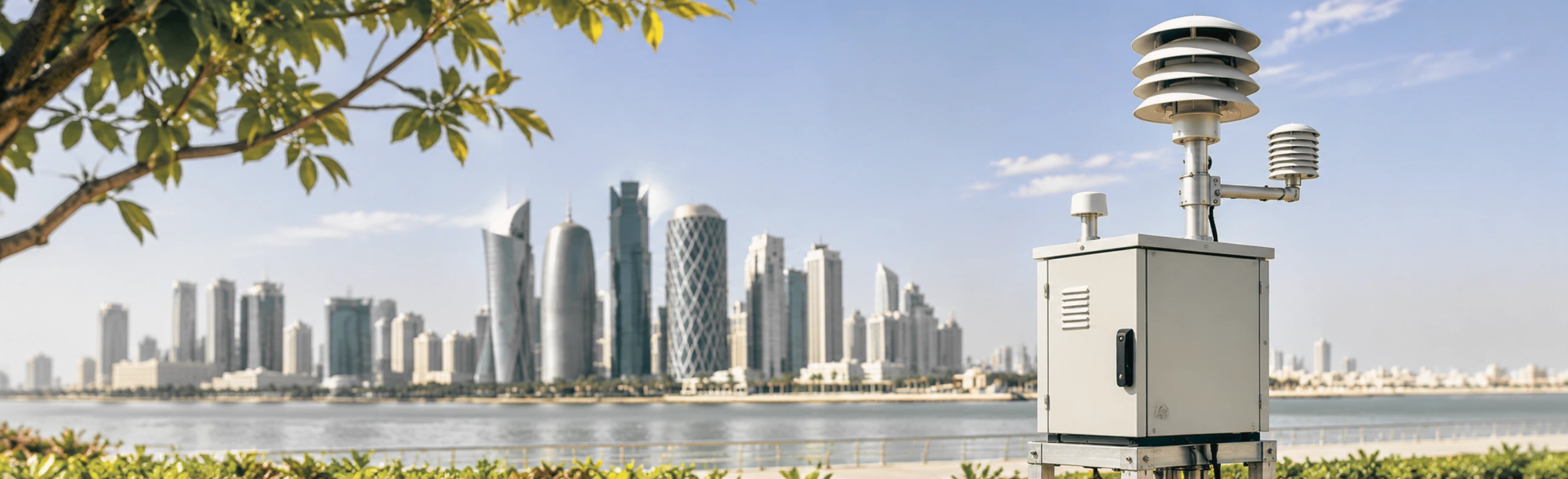
Dust, traffic fumes, industrial emissions, and poorly ventilated rooms all change the air people breathe, and most of these hazards are invisible. At METS Laboratories in Qatar, we monitor air quality by measuring pollutants outdoors and inside buildings. Our air sampling and analysis then compare the results with the limits that apply, so you can see where air quality stands. As a result, owners, operators, and consultants get data they can act on.
Air Quality Monitoring
Air quality monitoring measures the concentration of pollutants in air over a set period, and it compares the results with limits or guidelines.
- Ambient monitoring: Instruments measure outdoor air near roads, industrial sites, construction sites and communities.
- Indoor monitoring: Instruments measure air in offices, hospitals, schools, malls and car parks.
Need for Air Quality Monitoring
Poor air affects health and projects, so monitoring supports several goals.
- Health protection: Fine particles and gases harm the lungs and heart, especially in children and the elderly.
- Legal compliance: Permits and environmental approvals often require measured data.
- Baseline data: Impact assessments also need air quality records before a project starts.
- Building performance: Indoor data shows whether ventilation keeps occupants comfortable.
Regulatory Bodies and Requirements in Qatar
Several bodies shape air quality monitoring in Qatar.
- Ministry of Environment and Climate Change (MoECC): It runs the national monitoring network, which has more than 45 ambient stations and 20 roadside stations. It also publishes the public AQI for eight regions.
- Environment Protection Law (Law No. 30 of 2002): The law and its Executive By-law (Resolution No. 4 of 2005) set air quality standards and also require permits for facilities.
- Ashghal (Public Works Authority): It also applies sustainability criteria, including indoor air quality, to public buildings.
- GSAS (Global Sustainability Assessment System): This green building scheme requires indoor air quality monitoring for operations certification.
- Ministry of Public Health (MoPH): It protects public health, so indoor air guidance may apply to health facilities.
Air Quality Index (AQI)
The AQI turns pollutant concentrations into one number and one colour, so the public can understand air quality at a glance. The highest sub-index among pollutants such as PM2.5, PM10, ozone, nitrogen dioxide, sulphur dioxide and carbon monoxide sets the overall value. MoECC’s platform uses six categories.
| AQI Category | Typical Value Range | Meaning |
|---|---|---|
| Good | 0–50 | Little or no risk |
| Moderate | 51–100 | Acceptable, with some concern for sensitive people |
| Unhealthy for Sensitive Groups | 101–150 | Sensitive groups may feel effects |
| Unhealthy | 151–200 | Everyone may feel effects |
| Very Unhealthy | 201–300 | Health alert |
| Hazardous | 301–500 | Emergency conditions |
Laboratory measurements complement the AQI, because they give detailed site data at your exact location.
Pollutants We Monitor
| Pollutant | Main Sources | Example Method |
|---|---|---|
| PM10 and PM2.5 | Dust, traffic, construction, industry | Gravimetric (EN 12341); continuous analysers (EN 16450) |
| Nitrogen dioxide (NO2) | Traffic and combustion | Chemiluminescence (EN 14211); diffusion tubes (EN 16339) |
| Sulphur dioxide (SO2) | Fuel burning and industry | UV fluorescence (EN 14212) |
| Carbon monoxide (CO) | Traffic and combustion | Infrared analysis (EN 14626) |
| Ozone (O3) | Sunlight acting on other pollutants | UV photometry (EN 14625) |
| Benzene and VOCs | Fuels, solvents, building materials | EN 14662, ISO 16000-6, EPA TO-15 |
| Metals in particles | Industry and combustion | ICP-MS (EN 14902) |
| Formaldehyde (indoor) | Furniture and paints | ISO 16000-3 |
| Carbon dioxide, temperature and humidity (indoor) | People and ventilation | Sensors and data loggers |
Air Quality Monitoring Methods
Air quality monitoring methods depend on the pollutant, the site, and the goal.
- Continuous analysers: They measure gases and particles in real time, so they show peaks.
- Gravimetric sampling: A pump draws air through a filter, and the lab then weighs the particles.
- Active air sampling: A pump pulls air through sorbent tubes, canisters or liquids, and the lab then analyses what they capture.
- Passive air sampling: Diffusion tubes collect gases over days or weeks without a pump, so they suit wide surveys.
- Portable sensors and loggers: They track indoor parameters such as CO2, temperature and humidity.
Ambient Air Quality Monitoring
The common methods of ambient air monitoring are:
- Continuous analysers: Fixed or mobile stations measure gases such as nitrogen oxides, sulphur dioxide, ozone and carbon monoxide in real time.
- Particulate monitors: Instruments measure dust particles (PM10 and PM2.5) either continuously or by collecting them on filters for weighing in the lab.
- Passive samplers: Small tubes absorb pollutants such as nitrogen dioxide over days or weeks. They are low-cost and useful for comparing many locations.
Results are usually compared against the limits that apply to the site, and wind and weather data are recorded alongside to explain any peaks.
Indoor Air Quality Monitoring
The following are the common methods:
- Direct-reading instruments: Handheld or fixed meters give instant readings of carbon dioxide, temperature, humidity, carbon monoxide, and dust. Carbon dioxide is a good indicator of whether ventilation is adequate.
- Sorbent tube and cartridge sampling: Air is drawn through a tube or cartridge that traps chemicals such as volatile organic compounds (VOCs) and formaldehyde. The sample is then analysed in the lab.
- Microbial sampling: Air is drawn onto culture plates to count bacteria and mould, which is useful where damp or poor cleaning is suspected.
Indoor results are best read with the building’s use, occupancy and ventilation in mind.
Air Quality Monitoring Standards
The right standard for air quality monitoring methods depends on the pollutant and your market.
| Standard | Typical Use |
|---|---|
| EN 12341, EN 16450 | Particulate matter (PM10 and PM2.5) |
| EN 14211, EN 14212, EN 14625, EN 14626 | Nitrogen dioxide, sulphur dioxide, ozone and carbon monoxide |
| EN 14662, EN 14902 | Benzene and metals in particles |
| ISO 16000 series | Indoor air sampling and analysis |
| ASHRAE 62.1 and 55 | Ventilation and thermal comfort in buildings |
| WHO Air Quality Guidelines | Health-based reference values |
Who Needs Air Quality Monitoring?
Anyone who creates or breathes polluted air can benefit from air quality monitoring.
- Construction and industrial sites: Track dust and emissions at site boundaries.
- Environmental consultants: Collect baseline data for impact assessments.
- Developers and building managers: Verify indoor air quality and ventilation, especially after fit-out.
- Hospitals, schools and malls: Protect vulnerable occupants and also the public.
- HSE teams: Support workplace air checks and complaint investigations.
Air Quality Monitoring at METS Laboratories
Our air quality monitoring covers ambient and indoor air in one place, and three points set it apart.
- Ambient and indoor coverage: Outdoor surveys and building checks are also available together.
- Method range: Air sampling, continuous monitoring and laboratory analysis also work together.
- Clear reporting: We compare results with the standards and the AQI, so you see where you stand.
METS Laboratories delivers a complete portfolio of environmental monitoring services built on ISO/IEC 17025-accredited methodologies. These services support compliance with global and regional standards, including EPA, ISO, EN, BS, AS/NZS and GCC environmental frameworks.
Conclusion
You cannot judge air quality by looking at it, because the most harmful pollutants are invisible. If you manage a site, a building or a project, air quality monitoring gives you evidence. Then you can act on the results before a complaint or an inspection forces the issue. Contact METS Laboratories to discuss air quality monitoring and air sampling for your project in Qatar.
Frequently Asked Questions
What is the difference between ambient and indoor air quality monitoring?
Ambient monitoring measures outdoor air, whereas indoor monitoring measures air inside buildings. The pollutants, limits, and methods differ.
What does the AQI tell me?
It converts pollutant levels into one value and a colour category. It shows quickly whether air is healthy, but it does not replace site measurements.
What is air sampling?
Air sampling collects air or its contents on a filter, tube, or in a liquid, and then the lab analyses it. Samplers can be active (with a pump) or passive (without one).
Need Air Quality Monitoring for Your Project?
Contact METS Laboratories to discuss air quality monitoring and air sampling for your project in Qatar.
Get In Touch