
MIDDLE EAST TESTING SERVICES W.L.L QATAR
MIDDLE EAST TESTING SERVICES W.L.L QATAR
Pharmaceutical Quality Control Testing

PHARMACEUTICAL QUALITY CONTROL TESTING – Qatar MoPH & GCC Compliant Laboratory
Pharmaceutical Quality Control Testing is the scientific verification process that ensures every raw material, intermediate, and finished pharmaceutical product meets approved specifications before reaching patients.
In Qatar’s highly regulated healthcare environment, quality control testing is not only a GMP requirement — it is the analytical backbone that protects patient safety, supports regulatory compliance, and sustains pharmaceutical market authorization.
Mets Lab Qatar provides comprehensive PHARMACEUTICAL QUALITY CONTROL TESTING in Qatar, aligned with Ministry of Public Health (MoPH) regulations, GCC harmonized standards, and international pharmacopeial requirements.

Why PHARMACEUTICAL QUALITY CONTROL TESTING is Critical in Qatar
-
Patient Safety & Therapeutic Reliability:
QC testing confirms that medications distributed across Qatar:- Contain the correct active ingredient
- Meet approved potency levels
- Are free from harmful impurities
- Maintain microbiological safety
- Perform consistently batch after batch
-
Mandatory Regulatory Compliance:
All pharmaceutical products registered with Qatar MoPH must undergo validated QC testing prior to:- Product registration approval
- Batch release authorization
- Import clearance
- Post-approval change submission
-
Market Protection & Risk Prevention:
Comprehensive quality control programs prevent:- Product recalls
- Regulatory enforcement actions
- Import rejections
- Manufacturing license suspension
- Brand damage in GCC markets
Standards & Regulatory Framework We Follow
Qatar General Organization for Standards and Metrology:
Laboratory competence aligned with national quality infrastructure and ISO/IEC 17025 accreditation principles.Gulf Cooperation Council (GCC):
Testing programs structured to support centralized GCC pharmaceutical registration pathways.United States Pharmacopeia (USP):
European Pharmacopoeia (EP):
World Health Organization (WHO):
Analytical methodologies conform to internationally recognized pharmacopeial monographs
accepted by Qatar MoPH for products manufactured under FDA, EMA, or WHO-certified GMP
facilities.
Comprehensive PHARMACEUTICAL QUALITY CONTROL TESTING Capabilities
Identity Testing:
- FTIR & Raman spectroscopy
- Chromatographic retention comparison
- Chemical reaction verification
- Raw material authentication
Ensures ingredients exactly match regulatory dossiers submitted to Qatar authorities.
Assay & Potency Determination:
- HPLC & UPLC quantification
- UV-Visible spectrophotometry
- Titrimetric analysis
- Stability-indicating methods
Confirms active ingredient content meets approved specification limits.
Impurity & Degradation Profiling:
- Related substances analysis
- Residual solvent testing (GC)
- Elemental impurity analysis (ICP-MS)
- Forced degradation studies
Ensures purity compliance under Qatar MoPH and international guidelines.
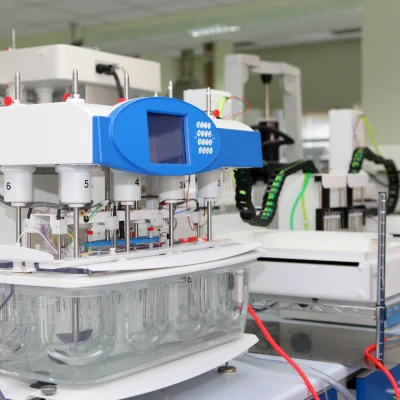
Dissolution & Drug Release Testing:
In vitro release assessment predicting bioavailability and confirming batch consistency for oral dosage forms distributed in Qatar.
Physical & Chemical Characterization:
- Particle size distribution
- Tablet hardness & friability
- Disintegration testing
- pH, osmolality & viscosity
- Moisture content (Karl Fischer)
Validates dosage form performance and stability under Qatar climatic conditions.
Microbiological Quality Testing:
- Bioburden enumeration
- Microbial limit testing
- Sterility testing
- Bacterial endotoxin testing
- Preservative efficacy testing
Critical for protecting patients receiving injectable and sterile medications.
Container Closure Integrity:
Evaluation of packaging systems to ensure protection against:
- Moisture ingress protection
- Oxygen permeation control
- Light exposure resistance
- Microbial contamination prevention
Especially important under Qatar’s high-temperature and humidity conditions.
Industries We Serve in Qatar
Our Distinctive Strengths
Advanced Analytical Infrastructure
State-of-the-art instrumentation portfolio including:
- UPLC-MS systems
- Gas Chromatography (GC)
- ICP-MS for elemental impurities
- Atomic spectroscopy
- High-resolution chromatographic systems
Qatar Regulatory Expertise
Deep understanding of documentation formats, testing frequencies, and regulatory submission expectations required by the Pharmacy & Drug Control Department.
Method Development & Validation
Analytical method validation aligned with ICH Q2 principles, ensuring suitability for regulatory submissions and lifecycle quality monitoring.
Climate-Specific Testing Insight
Specialized protocols evaluating pharmaceutical stability and performance under Qatar’s extreme environmental conditions.
Rapid Turnaround & High-Volume Capacity
Efficient workflow systems supporting:
- Commercial batch release
- Import verification
- Manufacturing scale-up
- Technology transfer validation
ISO/IEC 17025 Aligned Quality Systems
Comprehensive documentation, equipment qualification, personnel competency, and data integrity controls ensuring inspection readiness
Why Choose Mets Lab Qatar for PHARMACEUTICAL QUALITY CONTROL TESTING?
- Full-spectrum analytical capability
- Qatar MoPH regulatory alignment
- GCC registration support
- International pharmacopeial compliance
- Advanced instrumentation
- Audit-ready documentation systems
We deliver analytical excellence that strengthens regulatory compliance, supports pharmaceutical commercialization, and reinforces Qatar’s commitment to healthcare quality and National Vision 2030 objectives.
Stay Informed With METS Laboratories
Connect with us and get to know about our latest updates and service details
Need specialized chemical testing? Share your project details with us, and we'll provide a
personalized quote to meet your requirements
